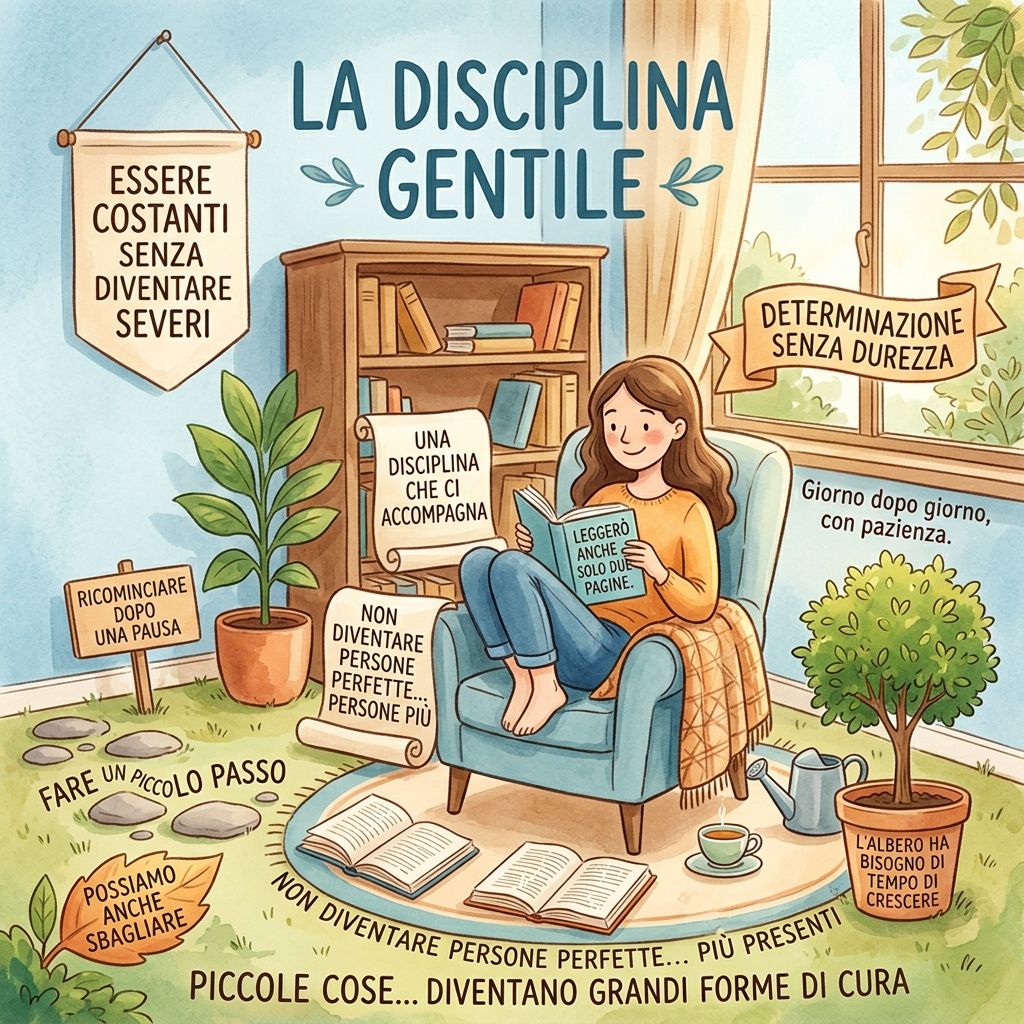
Gentle Discipline
When we hear the word discipline, we often imagine something rigid: rules to follow, commitments to keep, sacrifices to make. We think of willpower, the alarm going off early in the morning, and all the things we have to do even when we don’t feel like doing them. Sometimes, we even associate discipline with guilt: “I should be more consistent,” “I should try harder,” “I’m not good enough.”
But there is another way to look at discipline. A more human, compassionate and, perhaps, even more effective way: gentle discipline.
Gentle discipline doesn’t mean letting ourselves off the hook all the time, nor does it mean making excuses for constantly putting off the things we want to do. It means learning to stay consistent without being hard on ourselves. It means taking ourselves seriously without constantly putting ourselves down.
It is the ability to say, “This is important to me, and I want to keep doing it,” even when we’re not feeling particularly motivated.
Because motivation is a rather unpredictable companion. Sometimes it shows up full of enthusiasm, makes us feel like we can conquer the world, and convinces us that starting tomorrow, we’re going to completely change our lives. Then, a few days later, it may disappear without even saying goodbye.
Gentle discipline teaches us something different: we don’t have to feel motivated all the time in order to do the things that are good for us.
We can take things slowly.
We can take one small step.
We can start again after taking a break.
We can make mistakes, too.
And, above all, we can avoid turning every difficult day into a judgment about who we are.
Take, for example, someone who decides to read more. A rigid approach to discipline might turn that desire into an obligation: twenty pages every night, no exceptions. If we don’t manage it one evening, guilt can show up immediately.
Gentle discipline takes a different approach: “I’d like to read more because it makes me feel good. I don’t have much time tonight? I’ll read just two pages. I’m completely out of energy? That’s okay. I’ll pick it up again tomorrow.”
Two pages may not seem like much. But two pages are still closer to our goal than zero pages.
The same goes for exercise, eating well, work, studying, taking care of our relationships, and all those small habits that can make our lives better.
Real consistency doesn’t come from being perfect. It comes from being able to get back on track.
And that’s where gentle discipline becomes so meaningful: it doesn’t ask us to be flawless; it asks us to show up.
Some days, we’ll do really well. Other days, we’ll accomplish far less than we had planned. There will be days when we follow through on all our good intentions, and others when we feel like giving up altogether.
That doesn’t mean we’ve failed.
It means we’re human.
Gentle discipline also encourages us to distinguish between what is genuinely good for us and what we simply force ourselves to do because we think we “should” be doing it.
Because not everything that takes effort is necessarily important. And not everything that is difficult is necessarily worthwhile.
Before asking ourselves, “How can I become more disciplined?”, perhaps we should ask: “What is truly worth committing to?”
That question can change a lot.
If a particular habit helps us feel better, grow, take care of ourselves or the people we love, then we can try to build it patiently.
Without rushing.
Without constantly comparing ourselves to others.
Without expecting immediate results.
Because even discipline, when it becomes gentle, takes time.
A tree doesn’t grow any faster just because we look at it every day. We can water it, take care of it, and protect it when necessary. But then we also have to give it time to grow.
Perhaps we should do the same for ourselves.
Gentle discipline also means learning to keep the promises we make to ourselves, while allowing room for flexibility. It doesn’t mean always saying yes to others and no to ourselves. It means learning to recognize our needs and making real space for them in our daily lives.
Ten minutes of walking.
A few pages of a book.
A phone call to someone we care about.
A little tidying up.
A moment without our phone.
One small thing we’ve been putting off for a long time.
Small things that may seem insignificant, but when we repeat them over time, they can become meaningful acts of self-care.
And perhaps that’s really the point: gentle discipline isn’t about becoming perfect people. It’s about becoming more present in our own lives.
We don’t always have to do more.
Sometimes, we simply need to do a better job of what truly matters.
And when we don’t manage to do it, instead of telling ourselves, “I’m no good at this,” we can try a much simpler sentence:
“Okay. Today just didn’t go as planned. I’ll try again tomorrow.”
That isn’t weakness.
It’s perseverance without being harsh on ourselves.
It’s determination without rigidity.
It’s loving ourselves enough not to give up on what matters to us, while also loving ourselves enough not to punish ourselves when we stumble.
Because the healthiest kind of discipline isn’t the one that constantly pushes us to our limits.
It’s the one that stays with us, day after day.
With firmness when we need it.
With patience when necessary.
And, above all, with kindness.
Perhaps true discipline isn’t about becoming tougher on ourselves. Perhaps it’s about learning never to stop taking care of ourselves.
And that, after all, is a kind of discipline truly worth cultivating.
Sempreunagioia